Quick answer
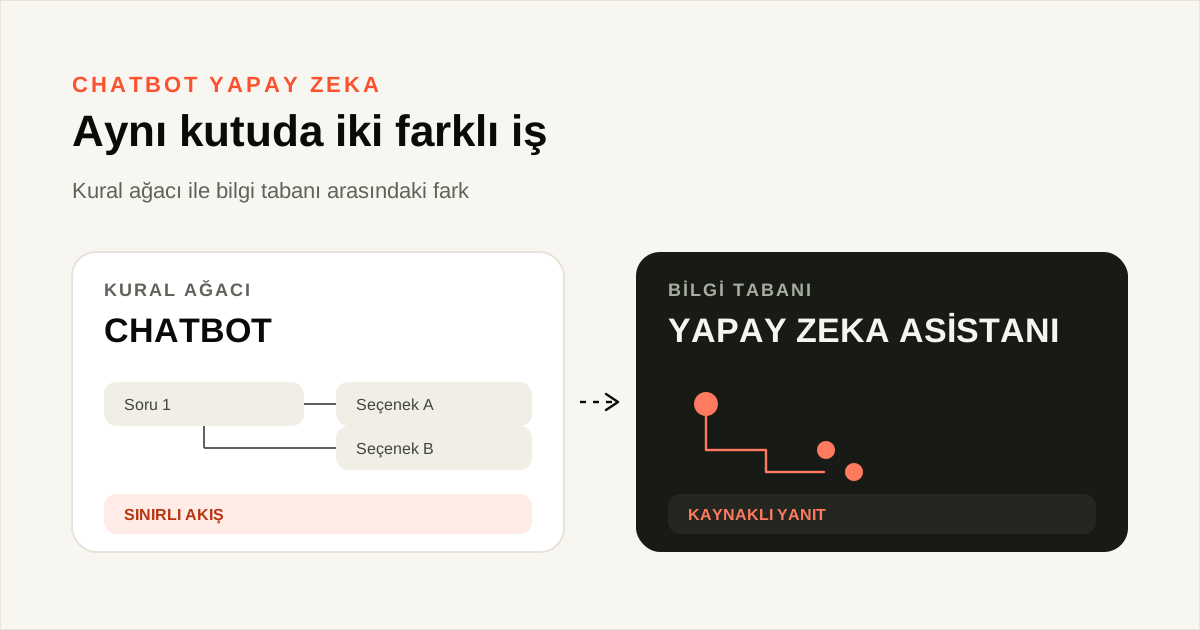
The decisive difference is not the label but where the answer comes from. A chatbot usually runs a pre-written rule tree; an AI assistant uses a knowledge base and conversation context, and hands over when it is unsure.
Chatbot vs AI assistant: where is the real difference?
Nielsen Norman Group defines a chatbot as "a text-based conversational interface that helps users with a limited set of tasks" [1]. Two words in that definition matter: limited and task. The strength of a chatbot sits there. It asks the same question in the same order every time and takes the flow to a clear destination.
The phrase "chatbot AI" often puts both ideas in one basket. Yet a chatbot, even with a large language model behind it, speaks only from its own rules when it is not connected to a knowledge base. An AI assistant looks at the source, carries the context and can show the basis of an answer. The difference is not marketing; it is behaviour.
What does a rule-tree chatbot do?
A rule tree is built on "ask this question first; if the answer is A, go there". When the user leaves the flow, the chatbot struggles to notice; NN/g's chatbot research shows that chatbots have difficulty when users deviate from a linear flow [1]. That does not make them useless. They remain practical for narrow flows such as choosing an appointment time, taking an order number or showing a campaign condition.
The problem starts when every new question is added to the rule tree. As the product list grows, campaigns change and customers use different words for the same thing, the number of rules increases. After a while the team chooses not to use the chatbot rather than update it.
What does a knowledge-based AI assistant do?
A knowledge-based assistant matches the question to connected sources first. A source can be a product page, a frequently asked question, a PDF, manually written text or a sitemap [3]. The answer is produced from that source; when there is no source, the assistant does not guess. Conversation context is kept because a customer who asks "and how long does that take?" expects the assistant to know which service the previous question was about.
The cost of this approach is preparation before setup. Critical items in the knowledge base, such as price, returns, delivery and warranty, cannot enter an answer before approval [3]. If the source is not ready, the assistant goes quiet. That silence may look like a poor experience, but it is safer than an invented answer. Salesforce describes Agentforce as a platform for AI agents [2]; the definition highlights carrying out a task in context.
Where do the two models part ways?
| Topic | Rule-tree chatbot | Knowledge-based AI assistant |
|---|---|---|
| Source of the answer | Pre-written flow and options | Connected knowledge base and conversation context |
| Unexpected question | Leaves the flow, gives a limited reply | Checks the source; hands over when it is missing |
| Update | Every scenario is rewritten | The source is updated and the answer refreshes |
| Handover | Must be defined as a rule | Hands over by itself when no source exists |
| Measurement | Flow completion rate | Resolution, handover and accuracy rates |
The last row of the table is often skipped. A chatbot's success is measured by "did the flow complete?". An assistant's success is measured by "did it give the right answer from the right source, and did it hand over to the right person when it could not?". The second measurement is harder, but closer to customer satisfaction.
Which job fits which model?
| Need | Better fit | Why |
|---|---|---|
| Fixed appointment flow | Rule-tree chatbot | Steps and options are known in advance |
| Product, service and process questions | Knowledge-based assistant | Question variety is high and the source changes |
| Order and shipment status | Assistant with an integration | A live source and verification are required |
| Campaign announcement | Rule-tree chatbot or bot message | One-way, limited content is enough |
| Complaint and exception | A person, supported by the assistant | Judgement and empathy are required |
Do not read this table as a prescription. Both models can run side by side in the same business. What matters is that the customer does not get two different answers to the same question and that the handover destination is clear. In a chatbot vs AI assistant comparison, the most common mistake is installing both at once without a rule between them.
Five decision questions
- How much of the question volume repeats? If the repeat rate is high and the answers are short, a rule tree can be a quick start. If the questions vary, a knowledge base is needed.
- Is there a source for the answer? If price, return and delivery facts are not written down, no model can answer reliably. Prepare the source first.
- What does a wrong answer cost? A wrong price or a wrong return fact damages reputation. When that risk exists, a handover rule is mandatory.
- Which channel will it run on? WhatsApp, Instagram, the web and the phone are not managed with the same rules. As the number of channels grows, the need for central management grows.
- Who will maintain it? If every new scenario needs a software team, a rule tree clogs over time. If the team can update the knowledge base, sustainability improves.
What goes wrong without a knowledge base?
The most expensive setup is the one built on an empty knowledge base. The assistant opens, gives a nice welcome message, then hands over every question. The team says "it does not work" on the first day; in reality, the assistant has no source. Changing the model, adding a feature or writing a longer instruction will not fix that.
The second misuse is overestimating a chatbot. Giving a rule tree the job to "answer every question" produces a bot with an unclear scope. When the customer leaves the flow, the bot either goes quiet or changes the subject. The work at that point is not to make the bot look smarter; it is to narrow the scope and define the handover.
The third misuse is in measurement: looking only at "how many conversations". In a chatbot vs AI assistant decision, the number of conversations is not meaningful on its own; resolved questions and the share of repeating topics are. If the same customer returns with the same question three times, the system is not working.
Which metric matters in a chatbot vs AI assistant decision?
Comparing a chatbot and an AI assistant on a feature list is easy, but misleading. If you do not track both models with the same measures, the question "which is better" stays in the air. With a rule tree you watch the flow completion rate; with a knowledge-based assistant you need to watch source-based answers, the handover reason and the repeat-question rate.
Before setting those metrics, set aside one week of real messages. Which questions repeat with the same words, and which are phrased differently every time? Repeating questions with short answers sit closer to a rule tree; variable questions that need a source sit closer to a knowledge base. Making the chatbot vs AI assistant distinction on that distribution is more reliable than a marketing promise.
The second leg of measurement is handover. Do not add a new feature without reading why conversations were handed over. If the same reason repeats for three weeks, the problem is not the intelligence of the bot; it is a gap in the knowledge base or a break in the flow. When you make the chatbot vs AI assistant choice with these two measures, it becomes clear where each model should stop.
Getting started
Before deciding, open the messages from the last week and sort them into three colours: resolved by a fixed flow, answerable from a knowledge base, and requiring a human decision. That distribution takes the choice out of guesswork. You can see how a knowledge base is built on the knowledge base product page, the assistant's current behaviour on the AI customer agent product page, and the whole picture in the AI assistant and customer agent guide. To try your own questions, use the signup page; related article: call center or AI assistant.
Sources
- [1] The User Experience of Chatbots — Nielsen Norman Group — https://www.nngroup.com/articles/chatbots/ — Accessed: 14.11.2026
- [2] Agentforce: The AI Agent Platform — Salesforce — https://www.salesforce.com/agentforce/ — Accessed: 14.11.2026
- [3] Knowledge base product page — YanıtLabs — https://yanitlabs.com/en/products/knowledge-base/ — Accessed: 14.11.2026
Frequently asked questions
Are a chatbot and an AI assistant the same thing?
No. A chatbot usually carries out a limited task with pre-written rules. An AI assistant uses a knowledge base and conversation context, and hands over when unsure. Even on the same channel, their scope and handover behaviour differ.
Does a chatbot use a knowledge base?
Some chatbots work only with a fixed menu and keywords; they do not use a knowledge base. More advanced setups can connect to one. But answering from a source, keeping context and going quiet when unsure are not chatbot features on their own.
Which one is cheaper?
Cost depends on usage volume and setup work. A simple rule tree may take less work at first; a knowledge-based assistant needs source preparation and approval. Compare maintenance, handover and the cost of a wrong answer, not just the software fee.
Which business should choose which?
If a fixed flow is enough for one task, a chatbot can be the simpler option. If product, service and process questions vary, several channels are in use and handover is needed, a knowledge-based AI assistant fits better. The choice follows the variety of questions.
Can they be used together?
Yes. Some businesses run fixed flows such as appointments or orders through a rule tree and leave open questions to the knowledge-based assistant. To avoid two different answers in one conversation, define the handover rule and the knowledge source in one place.