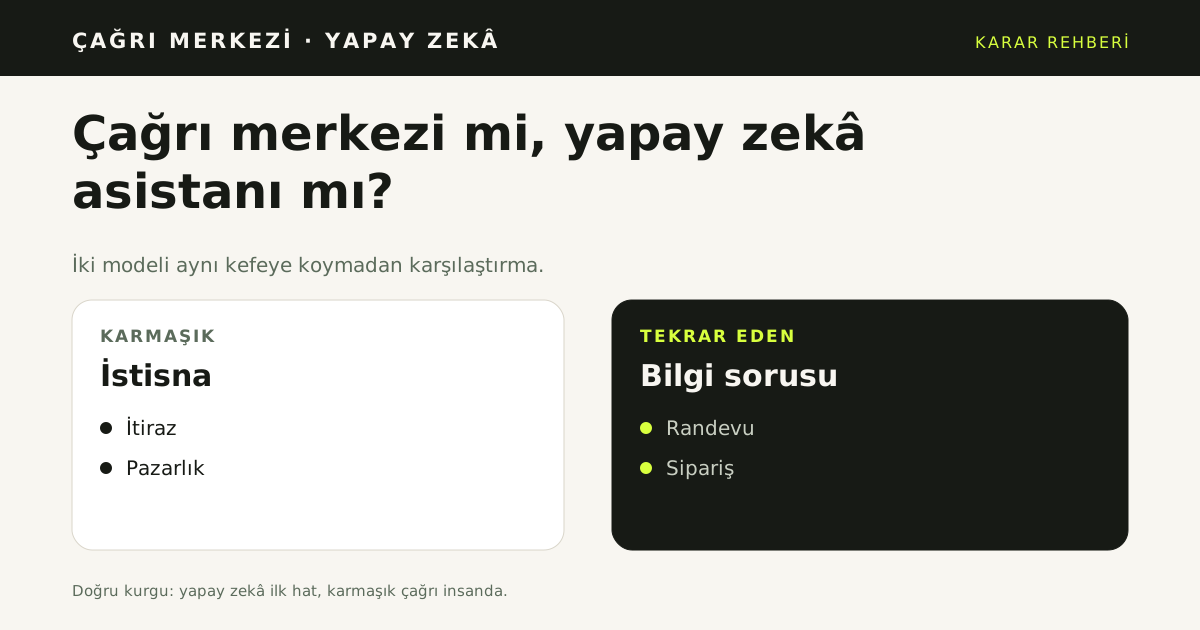
The choice between a call center and an AI assistant is a decision about call type and handover capacity. Phone is still one of the fastest ways for a customer to get an answer. But answering every call with a person is expensive and fragile, especially for a small team. The choice between a call center and an AI voice assistant has no universal answer; the right one depends on the type of call and the team’s capacity to take over. This guide compares the two models without pretending they do the same job, and gives the criteria that actually matter.
Quick answer
A call center is strongest for complex, exceptional and emotional calls; an AI voice assistant is strongest for repetitive calls it can answer from a knowledge base. For most SMEs the realistic setup is to make AI the first line and hand complex calls to a person.
Are a call center and an AI assistant the same job?
A call center is a human organisation. It needs agents, shifts, a team lead, training, quality checks and reporting. An AI voice assistant is a software layer: it answers an incoming call, speaks from the knowledge base, runs a booking or order flow and hands over when it is unsure.
Comparing them as “cheap people” versus “expensive bots” misses the point. The useful question is: which calls genuinely need a human decision? The answer decides which model belongs where.
Where does a call center win?
A call center remains hard to replace when:
- The complaint is complex. A customer raises several issues at once and needs empathy plus authority to resolve them.
- Negotiation is involved. An agent can offer a quote within limits; a bot should not have that authority.
- The case is an exception. A refund approval, address change, custom order or legal matter needs a person.
- Emotions run high. Calming an angry or hurried customer is a different skill from giving information.
- The sale needs consulting. In high-value sales, a person can explore the need and shape the offer.
These are not failures of AI. They are areas deliberately reserved for people.
Where does an AI assistant win?
The YanıtLabs voice assistant answers incoming calls and runs company information, appointment, order or quote flows. It supports twelve Turkish voices and eight languages; Turkish is always first and cannot be disabled. Arabic is Beta. It is particularly useful for:
- Opening hours, address, services and prices. If the knowledge base is current, every caller gets the same correct answer.
- Appointment requests. The assistant offers a suitable time and creates a record; the approval mode depends on the business setting.
- Order status. With an order number and verification, it reads the shipping stage. Email is never asked on voice.
- Repeated questions. “When do you open?”, “Is there parking?”, “How do returns work?” no longer occupy a person.
The voice assistant guide covers the setup steps. The recording and transcript are written to the call record; the transcript appears in the inbox as a voice-transcript message. When a person takes over, they do not have to listen to the whole call from the start.
What are today’s limits of the voice assistant?
An honest comparison has to include the limits. Today:
- It is focused on inbound calls. Outbound calling is a separate module and Beta. It works only on a consented list; anyone who says “do not call” or presses 9 is removed from that business’s list. Outbound minutes come from the same voice package, there is no separate outbound fee, and the line and operator cost belong to the customer.
- Instant API transfer is on the roadmap. A transfer number can be defined, but this should not be mistaken for a full call-center queue.
- There is no automatic appointment reminder. A 24-hour or 2-hour SMS, WhatsApp or email reminder is not in the code; only a daily schedule email goes out when the business setting is on. Automatic reminders are marked “coming soon” with no date promised.
- Preview and quota limits apply. Preview allows ten listens and five conversations per day; listening is 20 seconds and a conversation 120 seconds. When the voice quota is exhausted, the service is not cut: the call drops to “message-taking” mode with a 120-second cap, and overage minutes are charged.
- Decisions and approvals stay with a person. It gives information and runs booking or order flows; refund approval, special pricing and case-specific solutions go to a person.
These limits rule out presenting the voice assistant as a complete replacement for a call center. The right frame is a first line and triage layer.
Which five criteria decide?
1. What volume do you handle?
If only a handful of calls arrive each day, a full-time call center is a heavy investment. If volume is high but the questions repeat, an AI assistant can carry the first line. If volume is high and every call is different, people stay at the centre.
Measure not only total calls but also the share of repeated calls and the handover rate. Those two numbers show whether AI will genuinely absorb work.
2. What scope can the assistant cover?
Every question the assistant can answer must exist in the knowledge base. No assistant knows everything. Once scope is clear, it is also clear which calls can be automated and which need a person.
Expand the knowledge base and the flows rather than inventing new capabilities. For example, “where is my order?” works when an order source is connected; without a source, the assistant does not know and must hand over.
3. How does handover work?
Handover is the most important criterion. When the assistant is unsure, it hands the conversation over with a summary and goes silent. The team takes over, replies and can return the conversation to AI. Without a handover rule, one of two things happens: the assistant invents an answer, or every call goes to a person and the automation saves nothing.
Set three triggers: no information, the customer asks for a person, the topic is sensitive. Written triggers tell both the team and the assistant what to do.
4. What does each side cost?
A call center’s cost is not just salaries. It includes the number of agents, shifts, a team lead, training, quality control, phone lines, recording and reporting tools. Turnover and retraining are hidden costs.
An AI voice assistant costs a business plan, a voice package and overage minutes. Current list prices are on the pricing page. With today’s list prices, one example: Growth at 7,900 TL (3 paid channels included) plus a 500-minute voice package at 6,000 TL, for 13,900 TL + VAT. The 1,000-minute package is 12,750 TL; each minute above 1,000 is 15 TL. Voice minutes do not consume the conversation quota. A 14-day trial is available.
That example is not a claim that AI is cheaper. A fair comparison puts the call center’s total cost, the assistant’s package and overage cost, and the cost of human handover in the same table. It must also account for the people still needed to answer the calls AI cannot handle.
5. Who is responsible for data?
The voice assistant produces call recordings and transcripts. Storing them, controlling access and deleting them is the business’s responsibility under data-protection rules. A call center keeps similar records; the difference is where the data is processed and by whom.
Ask three questions: How long are recordings kept? Who can access them? What happens when a customer asks for deletion? If those answers are not written down, neither model should be called “compliant” on its own. YanıtLabs’ data and privacy approach is summarised on the security page; the business still needs its own legal assessment.
What does a hybrid setup look like?
For most SMEs, the practical design is:
- The incoming call reaches AI first. The assistant introduces the business, understands the question and answers from the knowledge base.
- A booking or order flow runs if relevant. Appointment approval follows the business setting.
- A decision goes to a person. The handover arrives with a summary; the team takes over.
- The team can return the conversation to AI. Context stays with the customer when they write again.
In this design the call center is not removed; it focuses on fewer, higher-value calls. AI takes the calls that can be answered quickly.
How to run a pilot
Do not route every call to a new voice assistant on day one. Run a two-week pilot and measure four things:
- Automated resolution rate: calls closed without human involvement.
- Handover rate and reasons: which topics go to a person.
- Average call duration: calls that drag on or end early.
- Satisfaction: customer feedback where available; otherwise repeat-call rate.
At the end of the pilot, fill the gaps in the knowledge base. If most calls cluster around the same three questions, write those answers first instead of adding features.
Which five mistakes are common?
One: treating the voice assistant as a full replacement. Without a handover rule, that increases dissatisfaction.
Two: leaving the knowledge base thin. The assistant must not invent answers, but if it hands over every call it is not carrying any load. The balance is scope.
Three: looking only at the package price. Voice overage, human handover and line or operator fees are part of the total.
Four: ignoring recordings and transcripts. They improve quality but create data responsibility. Write the retention and deletion rule up front.
Five: selling a reminder that does not exist. There is no automatic appointment reminder today; only a daily schedule email. Calling it “coming soon” prevents later disappointment.
How do you compare call center and assistant costs?
Compare both sides at full cost. A call center carries gross salary, employer social-security contributions, meals, transport, leave, a team lead, training and quality checks. An assistant carries subscription, channel, conversation or message caps, voice minutes and the cost of the conversations it hands to a person [1]. Putting only a salary next to only a subscription produces a misleading result.
Google Cloud's conversational agent pricing shows how usage per turn and per voice second changes the total [1]. The assistant cost is not fixed; it moves with volume and scope. Call center cost moves with shifts and capacity in the same way. Use the same call volume, the same hourly distribution and the same handover rate on both sides.
Which cost lines are easy to miss?
Setup, number porting, training and integration are one-off items; mixing them into a monthly total distorts the table. Knowledge-base maintenance, channel approval and review are real work on the assistant side. Every conversation handed to a person brings part of the call center cost back. Compare on "resolved conversation", not on list price. Order tracking automation with an AI assistant shows what one narrow automation actually removes. Data retention and deletion duties sit under KVKK [2].
Conclusion: which setup fits you?
“Call center or AI assistant?” is really “which call goes to whom?”. Give repetitive, knowledge-base-answerable calls to AI; keep calls that need judgement, empathy and exceptions with people. When the two models are treated as two layers of the same line rather than rivals, customers are not left with a bot and the team is not left with nothing but repeated questions.
Before deciding, record your calls for a week, group them under three headings and write the handover rule. That small preparation turns the choice from a guess into a measurable decision; related article: chatbot vs AI assistant.
Sources
- [1] Conversational Agents pricing — Google Cloud — https://cloud.google.com/products/conversational-agents/pricing — Accessed: 14.11.2026
- [2] Personal Data Protection Law and guidance — KVKK — https://www.kvkk.gov.tr/ — Accessed: 14.11.2026
Frequently asked questions
What is the core difference between a call center and an AI assistant?
A call center is a human organisation: agents, shifts, training and quality checks. An AI assistant is a software layer that answers from a knowledge base and runs flows. The difference shows in which scope technology and human judgement are used.
Which calls should go to a person?
Complex complaints, negotiation, exceptions, legal matters and emotionally heavy calls go to a person. The same applies when the customer asks for a human or the knowledge base has no answer. The handover summary must carry the customer need and what the assistant tried.
Does an AI assistant replace a call center?
No. The assistant takes repetitive calls that can be answered from a knowledge base; judgement, empathy and exceptions stay with people. The right setup uses AI as the first line and triage layer. The call center then focuses on fewer, more qualified calls.
How do you compare cost?
Write both sides at full cost. A call center carries gross salary, employer contributions, overhead, management and out-of-hours cover. An assistant carries subscription, channel, conversation caps, voice minutes and the cost of handovers. A comparison without the same volume and scope is misleading.
Which metrics does a pilot track?
Track the automated resolution rate, handover rate and reason, average call duration and repeat-call rate. Add satisfaction if you measure it. A two-week pilot shows the gaps in the knowledge base and whether the handover rule works.