Quick answer
An AI message is a pricing unit that counts every assistant reply; a conversation counts one customer thread as one unit. The same traffic produces different totals, so limits must be converted to the same unit before comparison.
Where should you start?
When comparing AI support plans, the first number people look at is usually “how many messages a month?” or “how many conversations a month?”. But those two phrases do not mean the same thing. This article explains how the two models work and the five questions to ask when you get a quote.
How do AI messages and conversations differ?
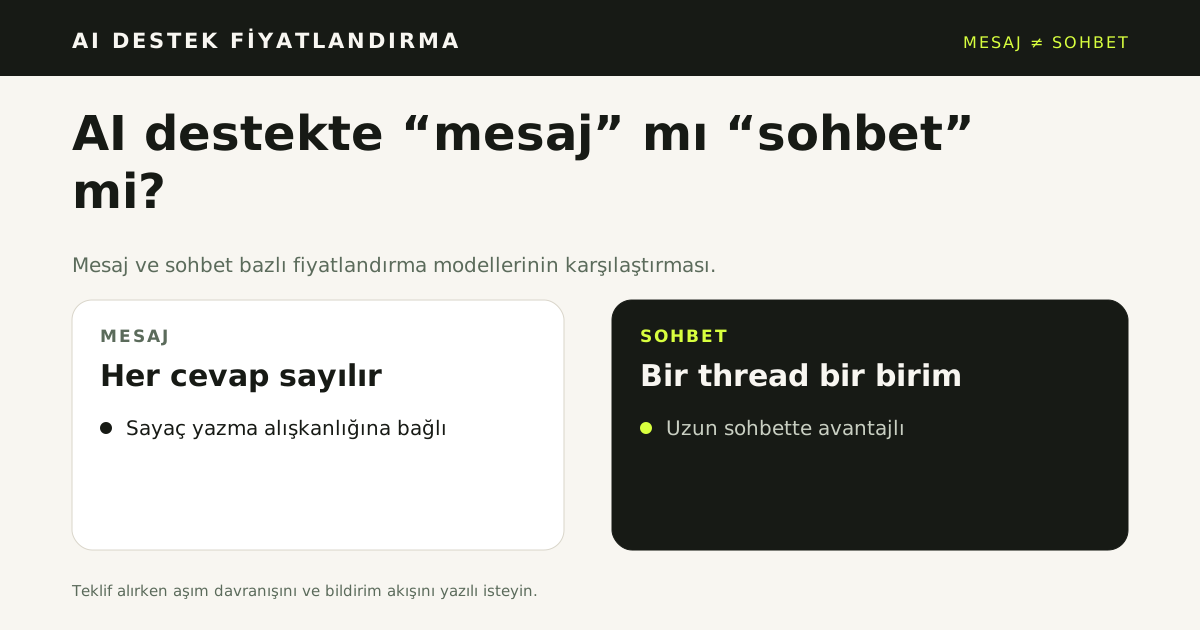
In a message-based model, every reply the assistant gives is counted. The customer writes “okay”, the assistant replies: two messages. If 25 messages go back and forth in the same conversation, 25 units are used. The price tag looks small, but the meter depends on how much the customer writes.
In a conversation-based model, one customer conversation (one thread) is one unit; whether 5 or 50 messages go back and forth, the meter moves by one. The price tag looks larger, but the customer does not have to track “how many messages are left”.
Most local providers in Turkey price by message, while most global players price by conversation, outcome or active person. Both are legitimate; what matters is converting the offer to the same unit before comparing.
Which five questions should you ask for a quote?
- “What exactly is one unit?” An incoming message, the assistant’s reply, or a conversation? The same word means different things at different providers.
- “How many messages does one conversation include?” If there is no limit, the cost works in your favour; if there is, ask for the number.
- “What happens when you go over?” Does the service stop, or is an overage fee applied? Get the unit price and the notification flow in writing.
- “Are messages counted after I hand over to a human?” Some providers charge for messages after handover too.
- “What happens when the limit is reached?” Does it stop automatically, or is there an overage invoice? The default behaviour should be in the contract.
How YanıtLabs counts
At YanıtLabs, the unit is the conversation: all messages a customer writes in one thread and all the assistant’s replies count as one conversation. There is no charge per message, so the assistant does not have to cut its answer short to protect a “message allowance”.
To keep cost predictable, every plan has a transparent AI message ceiling (Starter 4,500 · Growth 10,000 · Business 60,000). On average, that ceiling means 1 conversation ≈ 12–20 AI messages; it does not come into play in normal use and only protects against unusually long conversations. You are notified in the panel and by email as you approach it.
If the ceiling is exceeded, the service does not stop: an overage fee of 450 TL per 1,000 AI messages is added to your period invoice and the amount is visible live in the panel. If the same visitor writes again within 3 hours, the same conversation continues; “one conversation” is not counted twice.
How do you compare AI messages and conversations?
Convert the same traffic into both units. Take the last three months of conversations, average messages per thread and total monthly messages. In a message model the total is the number of assistant replies; in a conversation model it is the number of customer threads.
| Measure | AI message model | Conversation model |
|---|---|---|
| Unit | Every assistant reply | One customer conversation |
| Short thread | Few units | One unit |
| Long thread | Many units | One unit |
Which model fits which business?
A message model can be more predictable for short questions that close fast. Long support threads, multi-turn sales or technical support usually favour a conversation model. The decision depends on average thread length and overage price.
How is thread length measured?
Measure thread length as messages, turns and duration separately. Message count alone hides a short but multi-turn conversation. Sample the last three months and read the mean and the median together. The median stops a few long threads from distorting the average.
Split the measurement by channel. WhatsApp, Instagram and web chat have different thread lengths. A single average hides the expensive channel. Put messages and conversations per channel into a monthly table and choose the limit from that table.
Why do overage and notifications matter?
Write down whether service stops at the cap, how overage is charged and whether a notification is sent. A silent cut-off leaves customers without an answer. A surprise invoice breaks the budget. Both ends damage trust.
Tie notifications to two thresholds: eighty percent and one hundred percent. The first sends a warning, the second a status notice. Decide in advance whether overage auto-upgrades or stops service.
Which clauses belong in the contract?
The unit definition, limit, overage price, notification, period reset and termination terms must be written. Ask for measurable definitions instead of vague "fair use" wording. These clauses put two quotes into the same unit.
Which model fits you?
Ask four questions: how many messages is an average conversation, how many conversations per month, what happens at overage, and what is the handover rate? Those four answers make the difference between the models concrete.
OpenAI's API pricing page shows how usage-based cost moves [1]. Message and conversation models move with usage in the same way. AI messages and conversations in the assistant and call center or AI assistant for messages complete the other side of the comparison. Personal data processing falls under KVKK [2].
Summary: which model fits you?
- “Message” and “conversation” are not the same thing; convert the offer to the same unit before comparing.
- Measure your own conversation length: if the average is under 10 messages, a message model is usually better; above that, a conversation model usually is.
- Whichever model you choose, ask for the overage behaviour and the notification flow in writing.
If you want to compare with your own traffic, a 14-day trial lets you measure real conversations and watch conversation and AI message usage together in the panel; related article: AI handover to a human.
Sources
- [1] API pricing — OpenAI — https://platform.openai.com/docs/pricing — Accessed: 14.11.2026
- [2] Personal Data Protection Law and guidance — KVKK — https://www.kvkk.gov.tr/ — Accessed: 14.11.2026
Frequently asked questions
What is the difference between an AI message and a conversation?
An AI message counts every assistant reply separately. A conversation counts one customer thread as one unit. The same traffic produces different totals; limits must be converted to the same unit before comparison.
Which model fits better?
A message model is usually better for short threads; a conversation model is usually better for long, multi-turn threads. The decision depends on average thread length and overage price. A single list price is not enough.
Why ask about overage behaviour?
Write down whether service stops at the cap, how overage is charged and whether a notification is sent. A silent cut-off or a surprise invoice changes the total cost.
How is a conversation limit calculated?
Take the last three months of conversations, average messages per thread and peak-hour distribution. Choose the limit against that real traffic. Looking only at monthly message count hides long threads.
Which questions should you ask a vendor?
What is the unit, what happens at the cap, how is overage charged, is there a notification, and when does the limit reset? Written answers to these five questions put two quotes in the same unit. A verbal promise is not enough.