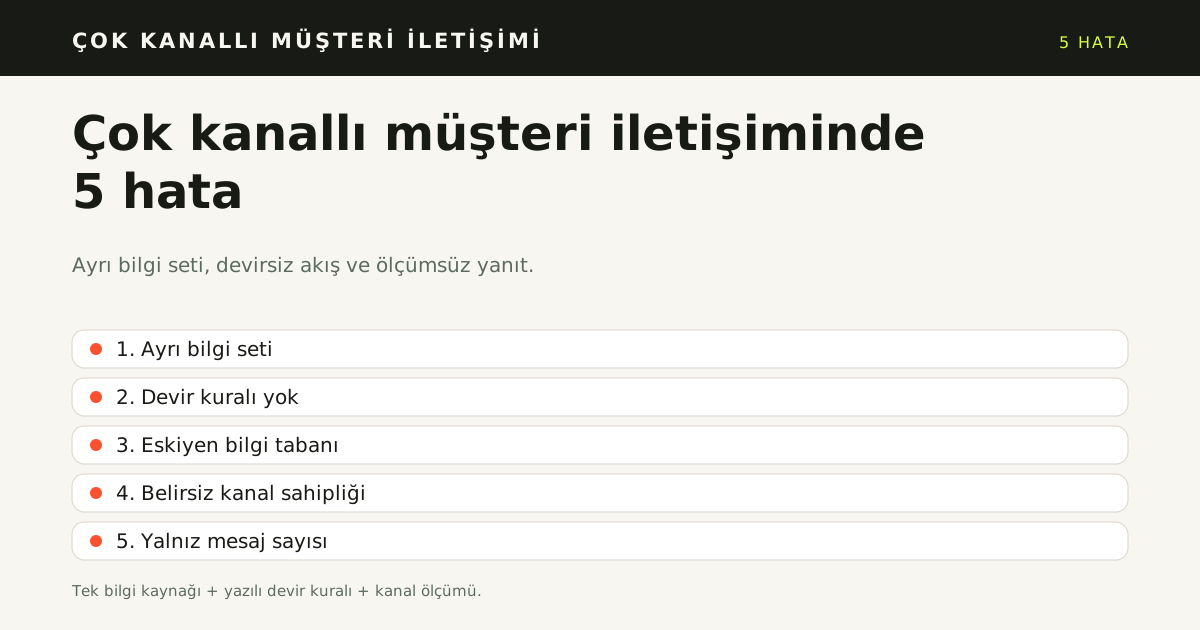
Multi-channel customer communication means answering questions from different channels consistently, from one knowledge base.
A customer messages on WhatsApp in the morning, leaves a question in the website chat at noon, asks for a price in an Instagram DM in the afternoon and clicks “Ask the seller” on a marketplace in the evening. Inside the business, each channel is a different screen, a different notification and often a different person. Even when every individual reply is correct, the customer can experience the whole as inconsistent. This guide looks at five common mistakes in multi-channel customer communication and how to prevent each one. The goal is not perfect automation. It is a reply system that does not break when the number of channels grows.
Quick answer
Multi-channel customer communication fails less often on a wrong answer than on an inconsistent one. Separate facts per channel, no written handover rule, a stale knowledge base, unclear channel ownership and measuring only message volume are the five common mistakes. The fix is one knowledge base and a measurable reply system.
Mistake 1: Why is a separate fact set per channel a problem?
Saying “Hi hun, it is 1,250 TL” on WhatsApp and “The price is stated in the system” on a marketplace, or sounding warm on one channel and distant on another, damages brand trust. Worse is telling two channels two different prices, delivery times or return terms. The customer reads this as “they answer differently depending on who is asking”.
The cause is usually not the number of channels. It is the number of knowledge sources. When each channel keeps its own canned-reply file, price list and FAQ, one gets updated and the others stay old. The team then cannot tell which version is correct.
How to prevent it. Build one knowledge base and read price, opening hours, delivery, returns and warranty from it. What changes by channel should be style and format, not facts. WhatsApp can be short and conversational, a marketplace reply can be more formal and rule-oriented, and email can be more detailed. All three must state the same price and the same terms. In YanıtLabs, WhatsApp, Instagram, Telegram, the web widget and marketplaces read from the same knowledge base; the multi-channel support guide explains that shared layer.
Mistake 2: Why is a human-handover rule required?
Without a handover rule, one of two extremes appears. In the first, the assistant tries to answer even when it does not know, inventing a price, a return term or a legal position. In the second, it sends every question to a person, so the speed gain disappears and the team carries the same load.
A handover rule has to be more specific than “hand over if I do not know”. It should state when, to whom, with what context and within what time. For example:
- A question with no answer in the knowledge base
- A customer who explicitly asks for a person
- A discount, negotiation or case-specific price request
- A complaint, a return dispute or a legal matter
- A message containing personal data that must not be answered publicly
- A high-value sale or a custom-production request
Handover should happen with a summary of the conversation, not with an “I do not know” message. The team member needs to see what the customer asked, which channel it came from and what the assistant already said. After handover the assistant should stop; once the team has replied, it should be able to return the conversation to AI if it wants to. Otherwise the customer has to explain the same problem twice.
Mistake 3: Why does a knowledge base go stale?
A knowledge base that is filled once and abandoned works well in the first month and starts giving wrong answers by the third. A campaign ends, a price changes, opening hours move, a new product arrives, but the assistant still reads the old text. That is worse than no answer: it gives the customer wrong information, and the business discovers it only when a complaint arrives.
Staleness appears in three forms: clearly wrong facts (an old price), missing facts (a new service that was never written down) and conflicting facts (two different delivery times on two pages). All three damage trust in the same way.
How to prevent it. Give the knowledge base an owner and write update triggers: when a price changes, when a campaign starts and ends, when opening hours change, when a product or service is added. Send critical facts (price, returns, delivery, warranty) through an approval step; if ticking a box is not enough, also run the “add approved items to the knowledge base” action. An old source may not always be deletable, so verify the content before opening a new source. A monthly knowledge refresh is more effective than a large quarterly clean-up.
Mistake 4: Why does channel ownership stay unclear?
In a multi-channel team the most common sentence is “I do not watch that channel”. One person watches WhatsApp, another watches Instagram, and nobody watches the marketplace. The customer gets a fast reply on the busiest channel and an answer days later on the second. The same customer writing on two channels can receive two different answers.
Channel ownership does not mean “every channel needs its own manager”. What is needed is one inbox and a clear priority. Which channel matters most to the business? Where is response time most critical? Which channel is informational only? The answers should be written down.
How to prevent it. Connect the highest-volume channel first; in many businesses that is WhatsApp, but check your own data. Then add the website chat, then marketplaces. Give every channel a primary owner and a backup. Write down who receives notifications and during which hours the channel is watched. Bring marketplace questions into the same inbox instead of leaving them in a separate panel; otherwise the marketplace becomes the most neglected channel.
Mistake 5: Why does message volume mislead?
“We answered 4,000 messages this month” does not show that communication is healthy. Volume measures activity; it does not show speed, quality or resolution. A team that watches only volume will not notice a rising first-response time, a rising handover rate or the same question returning every week.
How to prevent it. Track five measures together: first response time, automated resolution rate, human-handover rate and reason, repeated-question mix, and customer satisfaction where available. Split them by channel, because WhatsApp first-response time and marketplace first-response time are not the same thing. Once a month, read the first ten handed-over conversations. That reading exposes the tone and the language that dashboards miss.
Which six steps close the five gaps?
1. Why is one source of truth required?
Put price, hours, address, delivery, returns and warranty in one place. Do not write separate text per channel; leave only a style difference. Give the knowledge base an owner and write the update triggers.
2. How do you map the channel estate?
Which channels produce messages, how much work does each create, and where is response time longest? Do not say “connect everything” before you have this table. Start with the highest-volume, most critical channel and add the rest in order.
3. How do you write the handover rule?
Define on one page what happens when the answer is missing, the customer asks for a person, the topic is sensitive or personal data is involved. Define which fields the handover summary carries: channel, question, product and the assistant’s reply. State that the assistant goes quiet after handover and that the team can return the conversation to AI.
4. How do you write a channel style guide?
The same fact can be shorter or longer by channel. Two sentences on WhatsApp, a paragraph in email and a rule-oriented reply on a marketplace can all be appropriate. Greeting, closing and sign-off should still follow the brand guide. Aim for “one brand, channel-appropriate format”, not “a different personality per channel”.
5. How do you treat consent per channel?
Every channel has its own permission and data rules. Do not take Instagram DM traffic live before Meta approval; follow the marketplace’s communication rules; never answer personal data in a public comment. For privacy, write retention, access and deletion rules once, under a single data policy, rather than per channel.
6. How do you define measurement up front?
Choose first response time, automated resolution, handover rate and reason, repeated questions and satisfaction. Write the formula and the channel scope for each. Treat the first two weeks as a baseline and compare like with like after a change.
Which limits does automation not remove?
Automation is powerful in multi-channel communication, but it is not unlimited. Channel connections depend on platform permissions. Meta approval, business verification and token expiry are not under the business’s control. Marketplace messages follow the marketplace’s own rules. Instagram post comments are a separate capability and Beta; automatic replies are off by default and, when enabled, work only in specific categories.
Integration status also differs by channel: IdeaSoft is coming soon, while Shopify and Ticimax are Beta. Before describing a channel as “fully automatic”, check which integration is in which state. The assistant should not decide returns, special prices, legal questions or case-specific solutions. Those belong to people, and the handover rule should say so explicitly.
Finally, automation does not guarantee satisfaction on its own. A wrong knowledge base, a wrong handover rule and a setup without measurement turn automation into a mistake generator rather than an accelerator. The first week of a setup should therefore be a flow test, not a technology demo.
What to measure
- First response time: the time between the incoming message and the first reply, calculated per channel.
- Automated resolution rate: the share of conversations closed without human involvement.
- Human-handover rate and reason: which topics are handed over, and from which channel.
- Repeated-question mix: the volume of the same three to five questions; it points to a gap in the knowledge base.
- Volume and response time by channel: which channel really carries the load, and which is neglected?
- Satisfaction or repeat contact: a survey if you have one; otherwise the share of customers who write again within a short period.
Read these on the same day of the month with the same definitions. If the definition changes, the comparison loses meaning. Before saying “this month is better”, there should be a written answer to “what was last month?”.
Which items belong on a quick checklist?
- Is there one knowledge base, with no separate price list per channel?
- Is there a written style guide per channel?
- Are the handover rule and the handover summary defined?
- Is there a rule that the assistant goes quiet after handover?
- Are the knowledge-base owner and update triggers clear?
- Does every channel have a primary owner and a backup?
- Do marketplace questions land in the same inbox?
- Are Meta/Instagram permissions and token expiry tracked?
- Are first response, resolution, handover and repeated questions measured?
- Is IdeaSoft described as coming soon and Shopify/Ticimax as Beta?
How do you keep a multi-channel knowledge base current?
A multi-channel knowledge base is one source, not one file per channel. Price, opening hours, delivery and return rules live in one approved place; channels only change tone and format. When a fact changes, it changes once and every channel reads the new version.
Set an owner and a review rhythm in three steps:
- Name one owner and one backup for the knowledge base.
- Review unanswered questions and handover reasons every month.
- Update the fact once and confirm every channel reads the new version.
A monthly review finds the gaps faster than a quarterly rewrite. Google Search Central's structured-data guidance makes the same point for visible answers: what the customer sees must match the recorded answer [1]. The multi-channel inbox holds every channel, and the multi-channel customer support guide walks through the channel inventory and priority order. Personal data per channel remains subject to KVKK [2].
Which metrics belong together?
Track first response time, resolution time, handover rate and reason, repeated-question rate and satisfaction together. Message volume alone shows neither quality nor the automation's contribution. Split every metric by channel and topic so a slow channel cannot hide inside an average.
Bottom line: which step comes first?
Success in multi-channel customer communication does not come from building a separate bot for every channel. It comes from one correct source of facts and a clear handover rule. As channels multiply, the reply style can change; price, hours, delivery and returns must not. Whichever channel the customer uses, they should feel they are talking to the same business.
Fixing the five mistakes does not require a large transformation: consolidate the knowledge base, write the handover rule, assign channel ownership, define the measures and clean out stale facts on a schedule. If YanıtLabs is part of that setup, start with the channels page to see which channels fit and the pricing page for limits. If you run an appointment-based business, the appointment feature page becomes part of the handover rule too. To try it, the signup page starts a 14-day trial; related article: AI customer agent.
Sources
- [1] Structured data: FAQPage — Google Search Central — https://developers.google.com/search/docs/appearance/structured-data/faqpage — Accessed: 14.11.2026
- [2] Personal Data Protection Law and guidance — KVKK — https://www.kvkk.gov.tr/ — Accessed: 14.11.2026
Frequently asked questions
What is the most common multi-channel mistake?
The most common mistake is writing a separate fact set and a separate voice for every channel. It produces different prices or conditions for the same question. The fix is one knowledge base and channel-specific tone only.
Why must the handover rule be written down?
Without a written rule the assistant either guesses or sends every question to a person. Define when, to whom, with what context and within what time a conversation is handed over. That definition reduces both team load and customer waiting.
How often should the knowledge base be updated?
Update it immediately when price, campaign, opening hours or return rules change. Review repeated questions and unanswered conversations monthly. Name an owner and an approval flow in writing.
How do you assign channel ownership?
Give every channel an owner and a backup. Write the priority order, the response-time target and the handover point. Marketplace questions arrive in the middle of a purchase decision and must not fall to the bottom of the queue.
Which metrics should you track?
Track first response time, resolution time, handover rate and reason, repeated-question rate and satisfaction. Message volume alone shows neither quality nor the automation's contribution. Split every metric by channel.