Quick answer
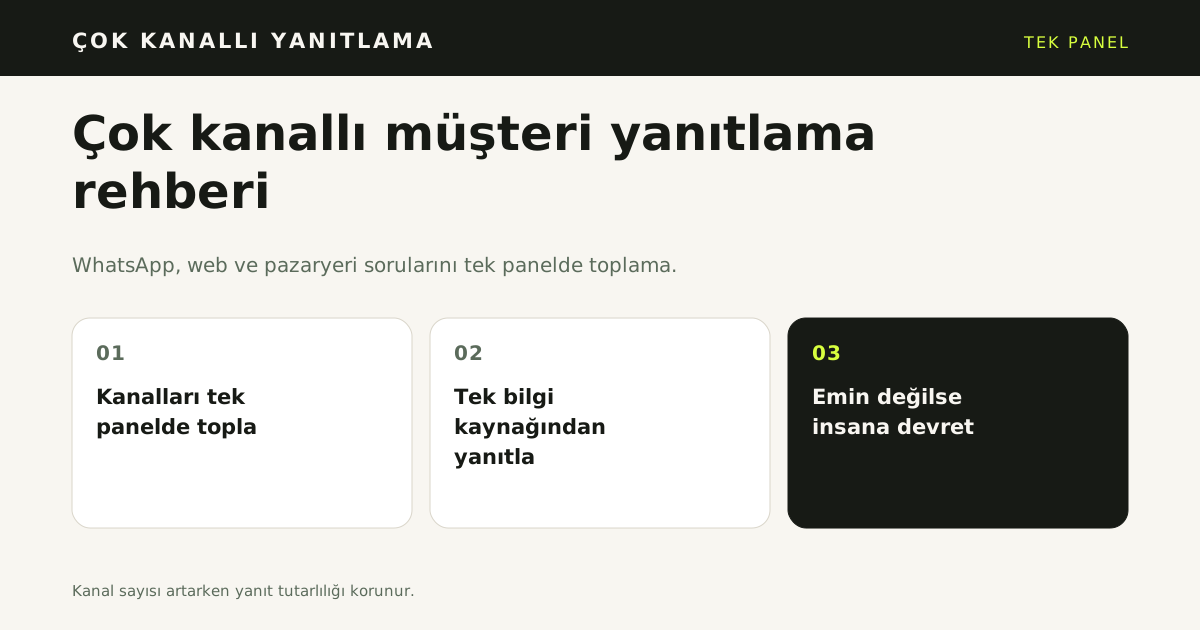
Multi-channel customer support means collecting WhatsApp, web, Instagram and marketplace questions in one inbox and answering them from one knowledge base. The assistant answers from that source and hands over with context when it is unsure.
Where should you start?
A customer question can arrive on WhatsApp, another through the chat box on your website, and a third through the “Ask the Seller” section on Trendyol. Each one appears on a different screen, with a different notification. This guide looks at where that fragmentation comes from, how a single AI-assisted inbox brings it together, and where automation should stop and hand over to a person.
Multi-channel customer support means collecting customer questions from different platforms in one interface and answering them consistently. This guide covers why the approach matters, the role of AI, which channels to prioritise, and how to set the right handover point.
Why one channel is not enough
Customers no longer write from a single place. On the same day, a question can arrive on WhatsApp, another request through the chat box on your website, and a product question through the “Ask the Seller” section on Trendyol (see supported channels). When each channel has its own screen, its own notification and often its own owner, response times stretch and some questions are missed altogether.
The cause is usually the setup, not the team: as the number of channels grows, so does the number of places to watch. A business that replies quickly on one channel may not keep the same pace on a second or third, because the person watching that channel is busy with something else or the notification was missed.
The practical result is that the customer has a different experience depending on the channel: a reply within minutes on WhatsApp, but a wait of days on a marketplace. Multi-channel customer support is designed to remove that inconsistency.
What is the role of AI in multi-channel support?
A general-purpose chatbot knows nothing about your business; you have to teach it everything by hand. An AI connected to your own knowledge base (web pages, PDFs, FAQ text) answers with information that is specific to your business and accurate. When you add a new channel, the knowledge base does not have to be rebuilt; the same source is used across every channel.
The practical result: a customer on WhatsApp and a customer writing through the website widget receive answers based on the same accurate information. When the knowledge base changes (a new product is added or opening hours change, for example), the change applies to every channel at once; there is no need to update each channel separately.
That is what makes multi-channel support scalable: as the number of channels grows, the maintenance burden does not.
Which channels come first?
Every business has its own channel priorities, but a general order works for multi-channel support.
First: WhatsApp. It is the channel customers in Turkey use most, and most questions arrive there. It should be the first connection.
Second: the website chat box. This is where a visitor asks a question while on a product page; it carries the highest purchase intent.
Third: marketplaces. Questions from Trendyol and Hepsiburada collect in a separate panel and are often the most neglected channel.
Fourth: Telegram and Instagram DM. Volume is lower, but if you close these channels, customers move elsewhere.
The practical benefit of this order: you do not have to connect everything at once when you move to multi-channel support. Starting with the busiest channel and expanding makes setup easier and delivers results sooner.
How do you automate marketplace questions?
Questions in the “Ask the Seller” section on marketplaces such as Trendyol and Hepsiburada are tracked separately from the store screen and are often answered late, because the team focuses first on its own website and WhatsApp line and the marketplace panel comes second.
Connecting those questions to the same knowledge base and answering them automatically reduces the work of checking the marketplace panel separately and shortens response time. When a customer gets a fast answer to the question they asked before buying, they trust that the same speed will continue after the sale.
For a closer look at marketplace questions, see our Trendyol “Ask the Seller” guide.
When should AI hand over to a human?
The goal of automation is not to remove human support entirely. When AI is unsure, or the topic is complex or sensitive, it should hand the conversation to the team. In a well-designed system, that handover is not a vague “I don’t know”: the conversation reaches the right team member with its context, so nobody has to read the whole thread from the start.
If the handover point is set badly, one of two extremes follows: either AI tries to answer even when it is unsure and makes mistakes, or it sends every small question to a person and removes the time savings that automation was meant to create. The right balance depends on the business’s risk tolerance and conversation volume.
In multi-channel support, the handover rule can also differ by channel. Marketplace questions can be handled more cautiously, for example, while the website chat can be more confident.
Why accurate contact information matters
When AI produces information that does not exist, such as a phone number, address or opening hours, it directly damages trust. That information must come from sources recorded and approved by the business, and information that is not on file must never be invented.
This is especially critical for verifiable details such as a phone number or social media account: a wrong number or address sends the customer to the wrong place and can break trust in a single interaction.
What does multi-channel support cost?
A common assumption is that a multi-channel setup costs more. The opposite is true, if the infrastructure is designed well.
The cost items are:
- A fixed fee per channel. Some channels carry an operator or platform fee that is independent of volume.
- A fee per conversation. WhatsApp in particular charges per conversation. Conversations started by the customer are usually cheaper.
- Team time. This is the largest item, and automation affects it directly.
Multi-channel support reduces team time because it answers repeated questions automatically. The saving comes from human hours, not from channel fees.
Which steps get multi-channel support started?
Moving to multi-channel support takes a few steps.
- Share your knowledge: add your web pages, PDFs and FAQ text. Your default AI assistant and website chat channel are created automatically.
- Connect your channels: add WhatsApp Business, Telegram or your marketplace accounts.
- Watch the answers: review what the AI replies and step in when needed.
- Collect records: keep shared contact details in the mini-CRM and let conversations with no activity close automatically.
The first two steps can be completed in a day. The real gain comes in the first weeks, when you see which questions repeat and strengthen the knowledge base.
How do you measure multi-channel customer support?
Measure first response time, resolution time, handover rate and reason, repeated-question rate and satisfaction together. Volume alone does not show whether quality holds as channels grow. Set the review rhythm in three steps:
- Tag every conversation with channel, topic and outcome.
- Track first response, resolution and handover time separately.
- Add the top ten repeated questions to the knowledge base every month.
Google Search Central's structured-data guidance makes the point for visible answers: what the customer sees must match the recorded answer [1]. The same rule applies across channels. The multi-channel inbox keeps every channel on one screen, and multi-channel customer support mistakes covers the obstacles. Personal data per channel remains subject to KVKK [2]. Multi-channel customer support also needs a named owner for the knowledge base, otherwise no one is accountable for stale facts. Multi-channel customer support improves when the same owner reviews handover reasons every month.
Which metrics belong together?
Track first response time, resolution time, handover rate and reason, repeated-question rate and satisfaction together. Split every metric by channel and topic so a slow channel cannot hide inside an average.
Summary: what does multi-channel support deliver?
Multi-channel support produces three concrete outcomes. First, the customer gets the same accurate information whichever channel they use. Second, questions are not missed because the team works from one inbox. Third, repeated questions are answered automatically, so human time goes to conversations that genuinely need attention.
None of these outcomes comes from buying more software; they come from the right design: an up-to-date knowledge base, a clear handover rule and a measured response time. Moving to multi-channel support is therefore an operational decision as much as a technology decision.
Which opportunity exists for your agency?
Digital marketing agencies are also expanding their services by offering this kind of AI-assisted communication to their clients; agencies such as Argo Ajans work in this area. If you are looking for a white-label solution for your own agency, see our agency programme; related articles: Telegram customer support, WhatsApp customer questions with AI.
Sources
- [1] Structured data: FAQPage — Google Search Central — https://developers.google.com/search/docs/appearance/structured-data/faqpage — Accessed: 14.11.2026
- [2] Personal Data Protection Law and guidance — KVKK — https://www.kvkk.gov.tr/ — Accessed: 14.11.2026
Frequently asked questions
What is multi-channel customer support?
It means collecting customer questions from different channels in one inbox and answering them consistently from one knowledge base. The number of channels can grow; the source of the answer and the handover rule stay shared.
How are channels collected in one inbox?
Each channel connects to the panel through its official connection. WhatsApp, Instagram, Telegram, web chat and marketplace questions land in the same inbox. The team sees the whole conversation without switching channel.
When is a conversation handed to a person?
It hands over when the knowledge base has no answer, the customer asks for a person, the topic is a complaint or sensitive, or a special price is needed. The summary carries the customer need and what the assistant tried.
Why should the knowledge base be single?
If every channel keeps its own price, hours or return text, one update leaves the others stale. A single source gives the same answer to the same question. Only tone and format change per channel.
Which metrics are tracked?
First response time, resolution time, handover rate and reason, repeated-question rate and satisfaction are tracked. Message volume alone does not show quality. Metrics must be split by channel.