Quick answer
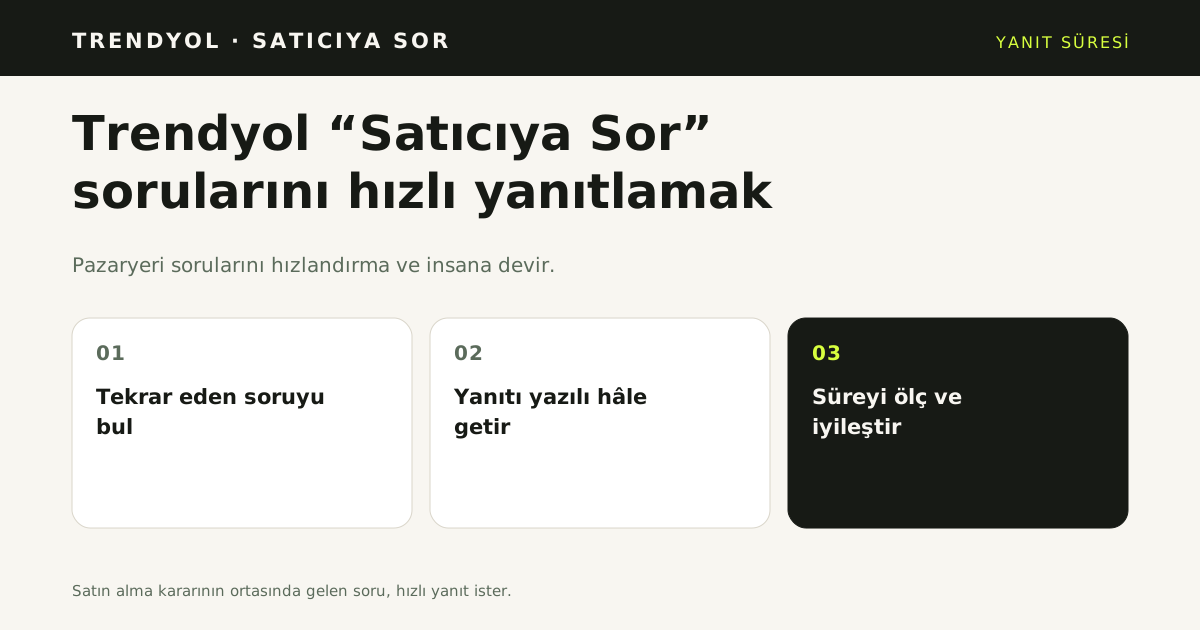
Marketplace questions are a support type that arrives in the middle of a purchase decision and needs a fast answer. Answer Trendyol Ask the Seller questions from one knowledge base, automate the repeated ones and leave judgement calls to a person.
Where should you start?
On Trendyol, a customer opens a product page, looks at the photos, sees the price and then pauses. A question comes to mind: “Will this size fit me?”, “How many days does shipping take?”, “If I return it, who pays the shipping?” These questions land in the Trendyol “Ask the Seller” section and are asked in the middle of the purchase decision. This guide looks at why they pile up, how response time affects sales and how to speed up the process.
Why Trendyol “Ask the Seller” is so critical
Because these questions arrive when purchase intent is at its highest. The customer already likes the product; the only missing piece is information. If they get it quickly, they buy; if not, they close the tab.
On a marketplace, this behaviour has an invisible cost: the customer does not just give up on you, they move straight to a competing seller. Among dozens of sellers offering the same product, the one who answers wins.
The “Ask the Seller” section also works apart from other channels. Questions from your website or WhatsApp collect on one screen, marketplace questions on another. That split explains why Trendyol “Ask the Seller” questions are constantly pushed to the background.
Why questions pile up
Many sellers treat the marketplace panel as a second job. First their own website, then WhatsApp, and the marketplace last. In that order, marketplace questions always wait.
There are a few typical reasons:
- The panel is somewhere else. A team member checks it once a day; by then, questions have accumulated.
- There are no notifications. Nobody is alerted when a new question arrives; it is seen only if someone happens to look.
- The answers live in someone’s head. The answer to “How long does shipping take for this product?” is in a person’s memory, not in a written source. If that person is away, the question waits.
- Volume is uneven. During campaigns, the number of questions multiplies and manual tracking collapses.
All four have the same root: the problem is the setup, not the team.
How response time affects sales
On a marketplace, the purchase decision is made quickly. If a customer likes a product, they usually buy it that day. If the question is not answered within that window, they either give up or buy from a competing seller.
The practical consequences are:
- A fast answer affects conversion directly. A customer who gets a reply within minutes makes the decision in the same session.
- A late answer loses the sale. A correct answer that arrives hours later is useless because the customer is now on another page.
- An unanswered question damages reputation. Unanswered questions remain visible in the Trendyol “Ask the Seller” section and make new customers hesitate.
So the measure is not only “how many questions were answered” but “how quickly they were answered”.
Measuring marketplace questions: which metrics matter?
You cannot improve what you do not measure. There are four metrics to track for marketplace questions.
Average first response time. The time between the question arriving and the first reply going out. This is the real wait for the customer and the most important measure.
Unanswered question rate. The share of questions with no reply in a given period. It should be close to zero; every unanswered question is a visible loss.
Automated resolution rate. The share of conversations closed without human involvement. This shows whether automation is actually working. If it is low, the knowledge base is weak or the handover rule is too sensitive.
Repeat-question mix. Seeing which questions keep arriving tells you where to invest in the knowledge base. The top three question topics usually make up half of the total volume.
Tracking these four monthly makes it clear where to improve. Otherwise you are left with an unmeasurable goal such as “let’s answer faster”.
How to speed up Trendyol “Ask the Seller” questions
The steps below are in an order a seller starting from scratch can follow.
- List the recurring questions. Review the questions from the last month. More than half probably fall under a few topics: size, shipping, returns, warranty, stock.
- Write a clear answer for each topic. The answers should be short, direct and compliant with seller rules. Once written down, the information no longer depends on a person.
- Build your knowledge base. Product descriptions, your return policy and FAQ text should live in one place. This speeds up manual replies and prepares the ground for automation.
- Set up notifications. Alerting the team when a new question arrives prevents questions from waiting for days.
- Turn on automation. Recurring questions can be answered automatically from the knowledge base. Topics where the system is unsure go to a human.
The first four steps make a big difference even without automation. The fifth adds scale.
Which questions should automation answer, and which should it not?
This distinction is the most critical decision for automation success.
Questions suitable for automation:
- Product features (“Is this product waterproof?”)
- Shipping and delivery times
- Return and exchange terms
- Opening hours and contact details
- Stock status
Questions that should stay with a human:
- Requests for a special discount or negotiation
- Complaints and objections
- Cases that need a tailored solution
- Legal or sensitive topics
The right design is this: automation answers quickly when it is confident, and when it is not, it passes the conversation to a human with its context. That handover should be a clear transfer, not a vague “I don’t know”, so the team member does not have to read the conversation from the beginning.
If you want to manage marketplace questions together with other channels, see the supported channels list. To see how the platform handles these questions, look at how it works.
How do marketplace questions combine with other channels?
Improving marketplace questions on their own is useful, but the real gain comes from collecting them in the same place as other channels.
The reason is simple: the same customer may write on Trendyol today, on WhatsApp tomorrow and on your website next week. When those three conversations are kept in separate places, the customer’s history is fragmented. The team member cannot see what the customer asked before and asks for the same information again.
When questions are collected in one inbox, three things change:
- Context is preserved. The question the customer asked on the marketplace sits next to the WhatsApp conversation.
- The knowledge base is shared. Information updated on one channel applies to all channels at once. There is no need to write separate text for each channel.
- Measurement becomes meaningful. Response times can be compared by channel and the weak link becomes visible.
The practical result is that marketplace questions stop being “the forgotten channel”.
How do you speed up marketplace questions?
Start by finding the repeated questions. Size, shipping, return and stock questions usually close with the same answer. Write those answers in one knowledge base; do not keep a separate text per channel.
Next, measure response time. First response, resolution time and handover rate must be tracked separately. Looking only at the average hides the questions that pile up at peak hours.
Which marketplace questions can be automated?
Product, shipping and return questions that are written in the knowledge base can be automated. Negotiation, special price, exceptional returns and complaints stay with a person. The Ask the Seller inbox for marketplace questions brings these questions to the same inbox. The WhatsApp Business API guide for marketplace questions covers combining them with other channels. The Ministry of Trade's e-commerce rules set out the seller's duties [1]. Personal data processing falls under KVKK [2].
Which mistakes are common?
First: answering only negative questions. Sellers often prioritise questions that contain complaints. Yet the questions that turn into sales are usually ordinary product questions.
Second: not personalising template replies. If the customer does not feel that their own question was answered, an automatic reply does not build trust. The reply must clearly relate to the question.
Third: not updating the knowledge base. If the knowledge base is not updated when a campaign ends, stock changes or shipping times differ, the customer gets wrong information. That is worse than not answering at all.
Fourth: not measuring. You cannot improve without knowing which questions were resolved automatically. Automated resolution rate and average response time are the two basic measures to track.
What should you do first?
Improving Trendyol “Ask the Seller” questions does not require a big budget. It requires identifying recurring questions and writing down the answers. Those two steps alone reduce response time noticeably.
With automation added, the gain is not only speed: the team can focus on conversations that genuinely need attention. Marketplace questions stop being a burden and become a channel that runs smoothly.
Sources
- [1] E-commerce rules — Ministry of Trade — https://www.ticaret.gov.tr/ — Accessed: 14.11.2026
- [2] Personal Data Protection Law and guidance — KVKK — https://www.kvkk.gov.tr/ — Accessed: 14.11.2026
Frequently asked questions
Why do Trendyol Ask the Seller questions pile up?
Questions arrive in the middle of the purchase decision and many repeat. When the team also watches other channels, marketplace questions fall to the second plan. Without notification and ownership, the question waits.
How does response time affect sales?
The customer already likes the product; the only gap is one fact. A late answer can send them to another seller. A fast, correct answer closes the decision in the same session.
Which questions can be automated?
Questions about size, material, shipping time, return rules and stock can be automated when they are in the knowledge base. Order and shipping status can be read from a connected source. If the source has no answer, the assistant does not invent one.
Which questions should stay with a person?
Negotiation, special price, exceptional returns, complaints and legal matters stay with a person. The conversation also goes to a person when the customer asks. Handover must carry the conversation context.
Which metrics are tracked?
First response time, automated resolution rate, handover rate and reason, repeated-question rate and conversion are tracked. Reply count alone is not enough. Metrics should be split by product and category.