Instagram DM automation is a sales setup built from a Meta-approved connection, the business knowledge base and a clear handover rule. On Instagram, a post may start the sale, but the decision often happens in a DM. Someone sees a product, wants the price, asks about a size or checks whether it is in stock, and expects an answer while the interest is still fresh. This guide explains how to use AI in Instagram DMs without turning the conversation into canned replies: what to connect, what the assistant should know, how comments differ from messages, and where a person must take over.
Quick answer
Selling with AI in Instagram DMs rests on three pieces: a Meta-approved Instagram connection, your own knowledge base, and a clear handover rule. Without all three, automation is just a set of disconnected replies. The assistant does not close the sale; it answers the question, finds the right product and leaves decisions that need judgement to your team.
Why are Instagram DMs and comments different surfaces?
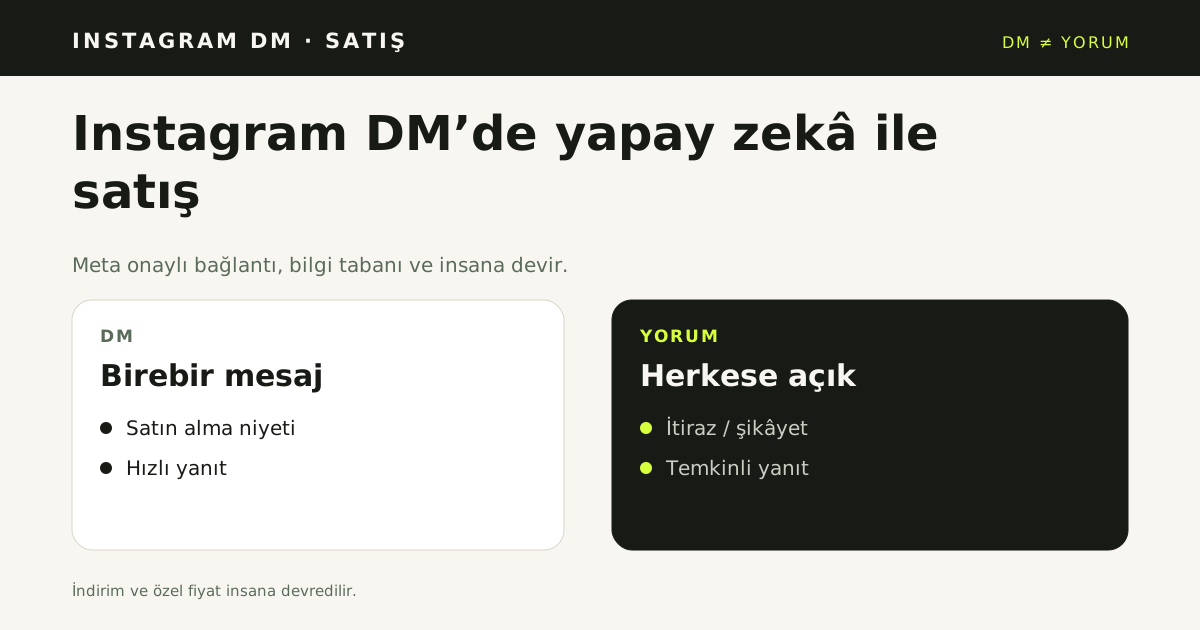
Instagram has two very different surfaces. A DM is a private message sent directly to the account. A post comment is public and can be read by everyone. Treating them as one automation channel damages both the customer experience and the brand.
People usually arrive in a DM with purchase intent: “Do you have this in a medium?”, “When will it ship?”, “What is your return policy?” A comment can be a question, but it can also be a complaint, a comparison or a public objection. The reply therefore needs a different tone and a different level of caution.
In YanıtLabs, Instagram and Facebook DMs land in one inbox. Post comments are managed in a separate Comments screen; Meta’s comment permission is off by default and the capability is marked Beta. Being explicit about this separation prevents the false expectation that “AI answers every comment”.
Which three questions drive the sale in Instagram DMs?
Most Instagram DM sales conversations come down to three topics:
- Product: size, material, colour, use, authenticity.
- Stock and delivery: is it available, when does it ship, where do you deliver?
- Returns and warranty: how many days, who pays the return shipping, how does an exchange work?
If those answers are not written down and current, the assistant cannot give a reliable reply. A generic chatbot does not know your stock codes, your carrier agreement or your return policy. An assistant tied to your knowledge base uses only approved information and does not invent a phone number or an address that is not in the source.
Which two setup paths and Meta approvals exist?
There are two ways to connect Instagram. With the Facebook Page path, the Instagram account must be linked to a Facebook Page. With Instagram Login only, no Facebook Page is needed; the connection is made with the Instagram account alone.
Both paths depend on Meta app permissions and business verification; the Instagram setup guide walks through the screen flow. Meta controls the timing and scope; no page can promise a review date. DM traffic is not taken live before approval. Once connected, the long-lived Instagram token is renewed every 60 days, with an automatic attempt 10 days before expiry. The token must be at least 24 hours old to renew. An expired token receives no new messages, so connection status deserves a regular look.
Three decisions belong at setup, not later:
- Which account is connected? A business account, not a personal profile.
- Which assistant answers? The same assistant record keeps the brand voice across channels.
- When does a person take over? Write the handover rule before launch.
Instagram counts as a paid channel. Starter includes no paid channels; Growth includes 3 and Business includes 10. Adding Instagram on Growth changes the channel count and, if applicable, the extra-channel fee. Check the current structure on the pricing page.
Why can you not sell without a knowledge base?
The most common mistake is switching the assistant on before it knows the business. For accurate answers, write down:
- Product pages and size charts
- Shipping times and delivery regions
- Return, exchange and warranty terms
- FAQ texts and short answers to repeated questions
- Store address, opening hours and contact details
Critical facts such as price, returns and delivery should pass an approval step before they become answers. When the knowledge base changes, DMs, WhatsApp and the web widget all read the same source, so the answers change together; the multi-channel guide explains the shared layer. That removes the need to maintain a separate script for every channel.
Which six steps build the Instagram DM sales flow?
Treat AI in Instagram DMs as a flow, not a single automatic reply:
- Meet the customer and pick up context. If the DM came from a post, understand which product started it. “Hello” alone is not enough.
- Clarify the question. Size, colour or delivery? Ask one question per message; do not turn the conversation into a form.
- Answer from the knowledge base. Give the product, shipping and return information from the source. Do not invent what is missing.
- Offer the next step. A product link, a size chart or a store direction. Links come only from verified pages.
- Hand over when judgement is needed. A discount, custom order, complaint or sensitive request goes to a person with a summary.
- Tag the record. Mark the request so you can see which questions turn into sales.
The goal is not to push the customer through a robot. It is to shorten the wait. When the assistant is unsure, it goes silent and hands over with context; the team does not have to read the whole thread from the beginning.
Why do comments need a separate screen and rules?
Post comments are a different surface, and today they are a separate Beta capability. In YanıtLabs they are collected in their own screen; Meta’s comment permission is off by default. Even when comment automation is enabled, the default behaviour is not automatic publishing: AI produces a draft, and a person edits and approves it.
When automatic mode is turned on, only questions and praise can be answered automatically. Complaints, insults, comments containing personal data and spam stay out of automation. A comment with personal data gets no public reply; it is handed to a person. There is a limit of 5 automatic replies per source per hour; when the limit is reached, the reply waits for approval. The DM redirect text is capped at 280 characters.
Knowing these limits is more honest than claiming that “AI manages every comment”. A comment is a public shop window; extra caution there is a deliberate safety choice, not a missing feature.
Why is handover where the sale is won or lost?
AI can speed up a sale, but it should not make every decision. A conversation should go to a person when:
- The customer explicitly asks for a human
- The customer asks for a discount, negotiation or special price
- There is a complaint, a return dispute or a legal issue
- The knowledge base has no answer
- Custom production, measurements or an appointment is required
Handover should carry a summary, not a vague “I don’t know”. The agent needs to see what was asked, which product started the conversation and what the assistant already said. After handover the assistant goes silent; the team replies and can return the conversation to AI later. The customer does not have to explain the same thing twice.
What to measure
Four measures are enough to see whether Instagram DM automation is working:
- First response time: from the DM to the first reply.
- Automated resolution rate: conversations closed without human involvement.
- Handover reasons: which topics end up with a person and where the knowledge base has gaps.
- Repeated-question mix: the volume of size, shipping and return questions.
If you want to track conversion, do it as a separate tag or report. “How many DMs arrived” is not meaningful on its own; what matters is how many reached the right product, the right information and the right person.
What data does Instagram DM automation read?
Instagram DM automation reads the conversation and the business knowledge base. Profile details, order numbers and messages are processed in the conversation context; payment data is never requested or stored. If price and stock do not come from a live catalog, the assistant does not guess; it uses the knowledge base and hands over when needed.
No DM traffic goes live before Meta approval. After connection, the token lifetime is monitored; an expired token stops new messages [2]. Meta's Instagram Platform documentation defines the permission and token model. Review the connection whenever permissions change.
How is user data protected?
Conversation records and message content are processed under KVKK [1]. Retention, access rights and deletion requests must be written down before launch. The assistant must not reveal order or address data without verification. Run Instagram DM and WhatsApp customer questions from one knowledge base with the same knowledge base and handover rule. One source keeps the answer consistent across both channels.
Instagram DM automation does not replace the sales team. It keeps the first Instagram DM answer fast, records the product question and passes the buying signal to a person. Review Instagram DM conversations weekly for missing facts. Use the Instagram DM inbox as the shared screen.
What should an Instagram DM answer include?
An Instagram DM answer should state the fact, the next step and the handover point. Do not promise a discount inside an Instagram DM; move that conversation to a person.
Which five mistakes are common?
One: treating DMs and comments as one channel. Comments are public; DMs are private. The same automatic reply in both places breaks the brand voice.
Two: planning Meta approval last. Traffic cannot go live before approval. Build the review time into the launch plan.
Three: letting the knowledge base go stale. When a campaign ends or stock changes, an old answer becomes wrong information. That is worse than no answer.
Four: handing everything to a person. An over-sensitive handover rule removes the speed benefit. Reserve it for decisions that genuinely need judgement.
Five: assuming comment automation is unlimited. Automatic replies are off by default, limited to certain categories and capped per hour. Do not turn those limits into a sales promise.
Which items belong on a launch checklist?
- Choose the Instagram business account and the connection path.
- Complete the Meta permissions and business verification.
- Load product, shipping, return and FAQ content into the knowledge base.
- Write the handover rule and name the person who receives the notification.
- Test with real DMs from your own account.
- Evaluate comment permission separately; set up the approval flow before enabling it.
- Review response time and handover reasons weekly for the first month.
Selling with AI in Instagram DMs is not about handing customers to a machine. It is about giving the right information quickly, stepping aside at the right moment and learning from every conversation. When those three pieces are in place, the DM stops being just a message box and becomes a working part of the sales process.
Sources
- [1] Personal Data Protection Law and guidance — KVKK — https://www.kvkk.gov.tr/ — Accessed: 14.11.2026
- [2] Instagram Platform documentation — Meta — https://developers.facebook.com/docs/instagram-platform — Accessed: 14.11.2026
Frequently asked questions
What is Instagram DM automation?
It is a Meta-approved Instagram connection, the business knowledge base and a clear handover rule answering DMs. The assistant answers product and process questions and does not commit to a price. It leaves judgement calls to the team.
Is a Facebook Page required for Instagram DMs?
The Facebook Page path requires a page. Instagram Login only does not need a Facebook Page. Both paths depend on Meta app permissions and business verification.
Are post comments answered automatically?
Comments are managed in a separate Comments screen. Meta's comment permission is off by default and the capability is Beta. Even when automatic replies are enabled, only questions and praise are answered; an AI draft is not published without human approval.
Can the assistant offer a discount?
No. Discounts, negotiation and case-specific pricing go to a person. The assistant gives product and process information from the knowledge base. Price commitments and special offers belong to the sales team.
Which metrics should you track?
Track first response time, automated resolution rate, handover rate and reason, conversion and repeated-question rate. Message volume alone does not show the sales contribution. Split metrics by channel and campaign.